The material field guide
What each material asks of you
Choose a packaging system, not a green-sounding ingredient. Protection, quantity and a realistic next destination belong in the same decision.
Begin with the job
A soft garment, a glass jar and a printed book do not need the same pack. List what can go wrong: abrasion, bending, moisture, crushing or movement inside the parcel. Then select the least material that reliably addresses those risks.
Compare complete systems rather than equal weights of raw material. A light mailer and a rigid box provide different functions. Include tape, labels, liners and inserts when you weigh a sample pack. If a material change increases damage, the replacement product and another shipment also belong in the assessment.

A practical material matrix
These are starting points, not universal ratings. Specifications and local collection rules can change the result.
| Material | Useful for | Check before buying | After delivery |
|---|---|---|---|
| Paper mailer | Dry, non-fragile items | Tear strength, coatings, seam design | Local paper acceptance; separate incompatible layers |
| Flexible plastic mailer | Light items needing moisture resistance | Puncture resistance, recycled content evidence | Film collection where explicitly accepted |
| Corrugated board | Stacking strength and structured protection | Board grade, dimensions, empty space | Keep clean and dry; flatten if locally requested |
| Moulded fibre | Fitted support for repeat product shapes | Fit, abrasion, additives, tooling needs | Check local acceptance of the finished component |
| Paper cushioning | Blocking, bracing and some surface protection | Compression behaviour and quantity needed | Clean paper collection where accepted |
Mailers: flexible is not automatically simple
Paper mailers can be useful for goods that tolerate bending and limited moisture exposure. However, a barrier coating or plastic lining may complicate recovery. Ask whether a supplier’s recycling claim applies to the finished mailer, including adhesive strips, rather than just the paper stock.
Flexible polyethylene mailers often use little material and resist rain, but film collection is not available everywhere. Do not tell every customer to put them in household recycling. Give destination-appropriate instructions and avoid implying that a resin identification code guarantees acceptance. Recycled content and recyclability are different properties: one describes inputs, the other a possible future route.
Cushioning: control movement first
Loose fill cannot compensate for a box that is much too large or a heavy item that is free to move. Begin by positioning the product and protecting vulnerable edges. Test whether your chosen cushion maintains its shape after compression and handling, not merely whether it looks generous when packed.
Air pillows are light but need intact seals and an appropriate film recovery route. Bubble cushioning can be useful for certain surfaces; paper may work better for blocking and bracing. Reused clean cushioning can avoid a new purchase, provided it has not lost the performance your product requires. Keep food, hygiene and product-specific requirements separate from ordinary parcel advice.
Paper alternatives still need scrutiny
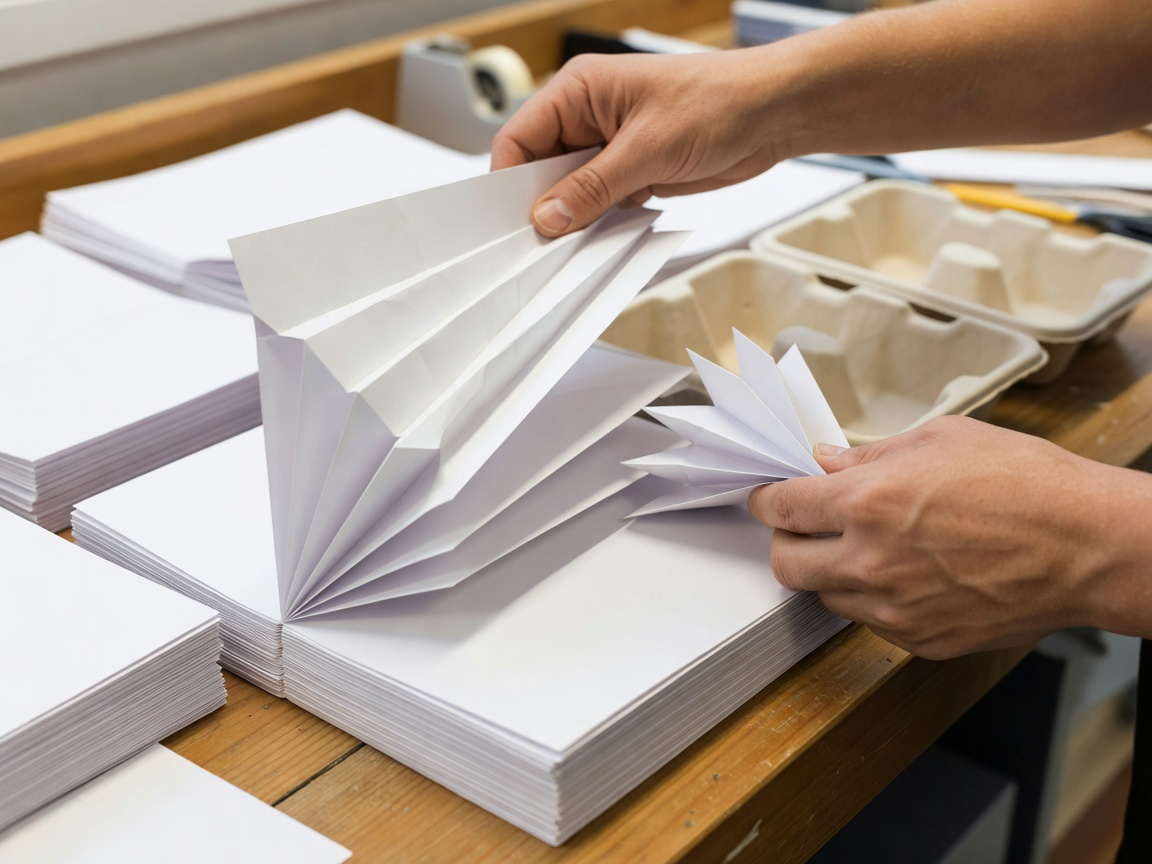
Moulded pulp, honeycomb paper and folded board can replace some plastic inserts. A fitted design may reduce movement without filling every empty corner. But paper-based does not mean lightweight, water-resistant or accepted by every paper mill. Ask about coatings, wet-strength treatments and separation steps.
Fibre sourcing and end-of-life claims answer different questions. FSC and PEFC are forest-related certification systems; their presence does not prove that a particular parcel component will be collected or recycled locally. Verify the scope and validity of any claim with the relevant scheme rather than copying a supplier’s badge into your own environmental statement.
Ask for evidence you can use
Request material composition, dimensions, weight, performance specifications and the basis for recycled-content claims. ISO 14040 and ISO 14044 provide life-cycle assessment frameworks; they do not award a universal winner to paper or plastic. If you receive a comparative study, check its product function, geography, energy assumptions and end-of-life scenarios.
For recycling information, start with the actual collector. Recycle Now in the United Kingdom and Earth911 in the United States can help readers investigate local options, but local authority or collection-provider instructions remain important. Describe uncertainty honestly: “check local film collection” is more useful than an unsupported “fully green” promise.